
The Last Mile of the Fax - Split, Redact, and Annotate
After Fax Transform shipped, one truth emerged: the magic wasn't in extraction — it was in what clinicians did next. I owned the second act end-to-end: the review surface where multi-patient faxes get split into correct records, sensitive data gets redacted before it touches the chart, and clinical signal gets annotated onto the artifact so nothing is ever re-read twice.
1
Designer, owned end-to-end
~1
Hour/day saved per reviewer
47
shadow hours at live review desks

Split
·
Redact
·
Annotate
·
HIPAA-grade
·
Enterprise-Ready
·
01 · Overview
The demo worked.
The workflow didn't.
That was my brief.
Role
Sole Product Designer · end-to-end
Scope
Research · IA · Interaction · Visual · QA
Platform
Web · tablet stylus · keyboard-first
Partners
3 engineers · 1 PM · clinical advisor
Outcome
First enterprise contracts · 2 health systems
02 · problem
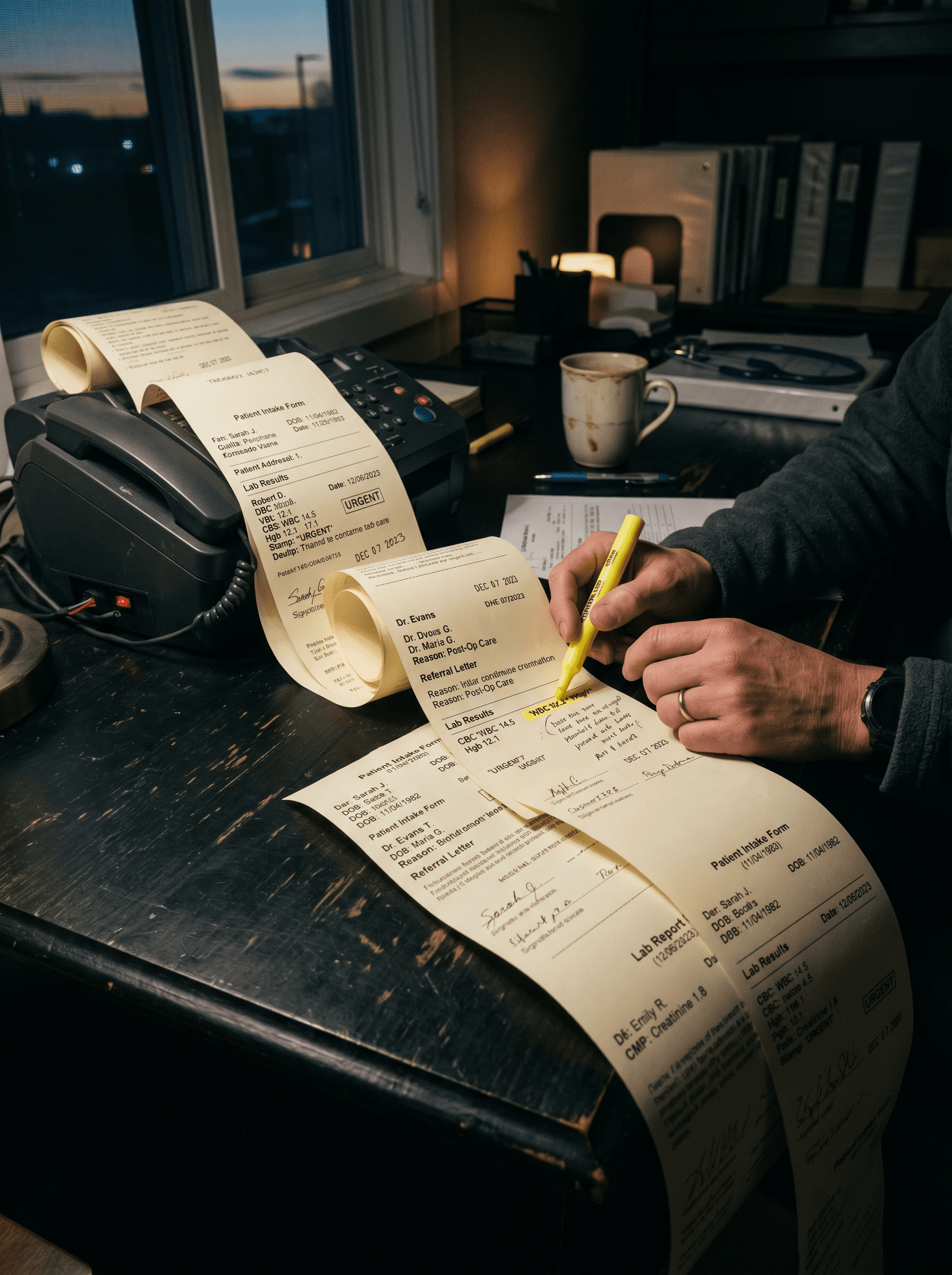
A single fax isn't a document. It's five patients' records printed as one.
Extraction got us to 97% field accuracy. The remaining mile — figuring out where one patient ends and the next begins, which boxes hide a Social Security number, which highlighted line is the reason the fax was sent at all — was still being done by hand.
The early Fax Transform review surface was a PDF viewer with a sidebar. It shipped because it worked for one patient per fax. In practice, a significant share of inbound faxes bundled two or more patients, and nearly all contained at least one field that had to be redacted before the document could be attached to a chart. The "last mile" was actually the whole marathon.
01
2.3 min average review time per page — up from 40s in the demo
02
Zero tooling for redaction — staff printed, blacked out with Sharpie, re-scanned
03
Zero tooling for annotation — staff have to use internal communication tool
“Your app is beautiful. I still have a Sharpie in my other hand because of page four.”
— Priya M., Medical Assistant · Horizon Family Care · review-session day 3
03 · RESEARCH
I watched 47 hours of review before I opened Figma.
04 · insights
Three craft decisions reframed what we were building.
01
Split is an assignment tool, not a cutting tool.
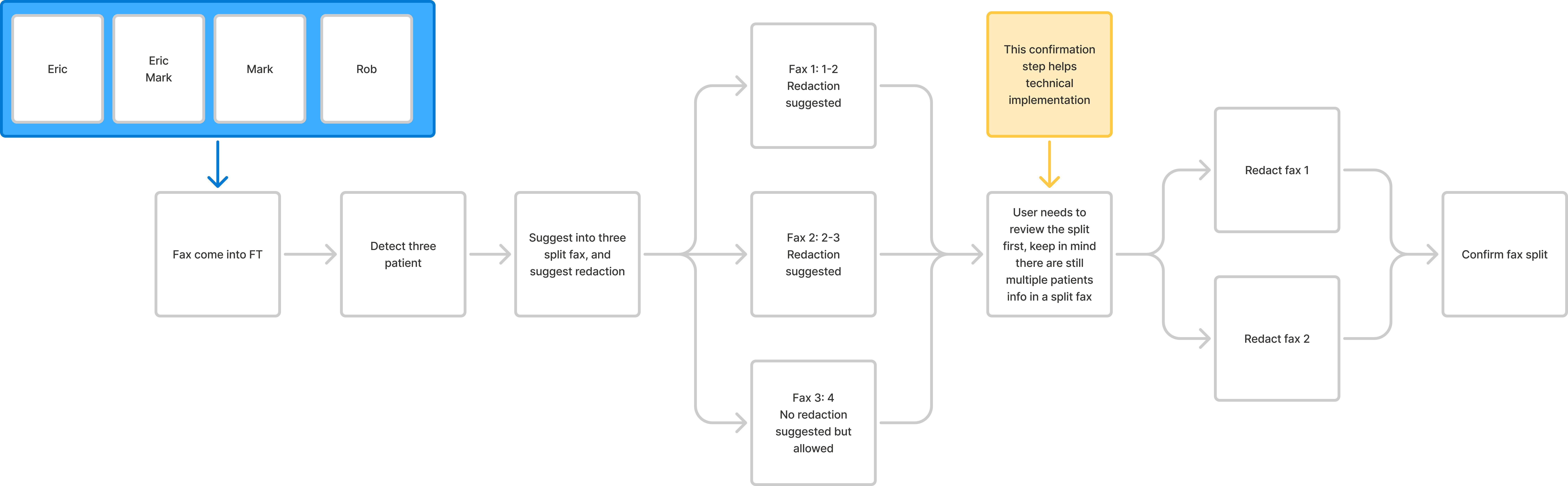
Early thinking framed split as dividing a document — placing cuts between pages. What reviewers actually needed was to assign pages to patients. "Pages 1–3 belong to Eric Nam, pages 2–3 belong to Mark Whitaker." The mental model shifted from scissors to a roster. The design followed.
02
Redaction should be manual, never automated.
A mis-redaction isn't a bug — it's a compliance incident. We don't surface AI suggestions or auto-redact candidates. The reviewer adds each redaction themselves, specifies the page, and optionally describes what was redacted. The human is the last signature, always.
03
The confirmation step is part of the design, not a formality.
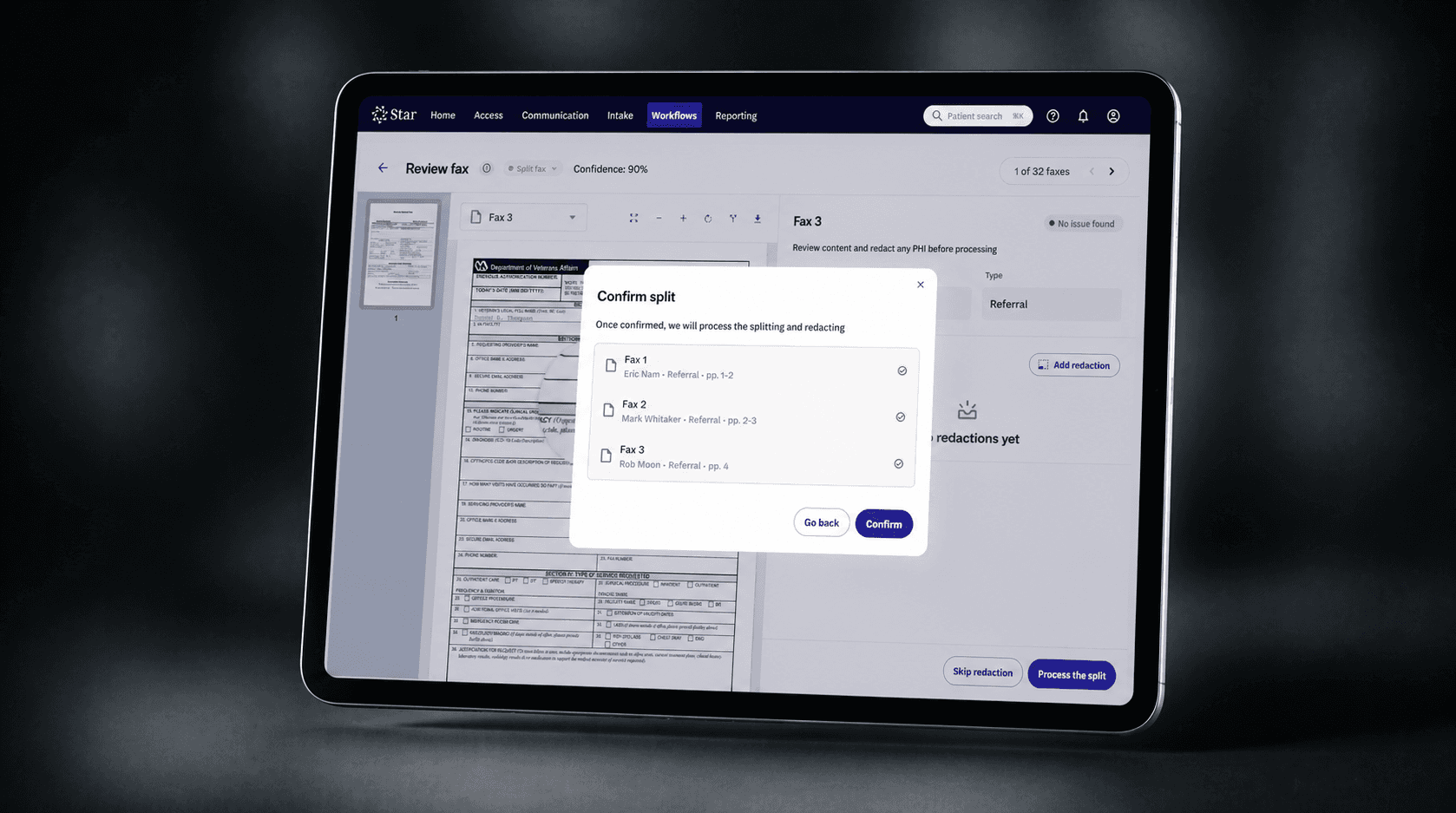
Before any split is processed, the reviewer sees a summary: every fax, every patient, every page range, every PHI warning — in one modal. This wasn't a safeguard bolted on at the end. It's where the work becomes legible. The moment a reviewer can scan the whole thing and say "yes, that's right" is the moment the tool earns their trust.
05 · solution
One queue.
One workspace.
No jumping between tools.
The queue shows every incoming fax with patient match status, document type, confidence score, and who last touched it. A reviewer opens a fax and sees it whole — the document on the left, the work on the right. They assign pages to patients, flag any PHI, and confirm before anything moves to the chart. No context switches. No separate redaction tool. No printing.
Craft principles
06 · the flows
Three tools. Two flows. One direction. Nothing processed until it's right.
Each flow was prototyped and tested with clinicians against one benchmark: could they process a multi-patient fax faster and more accurately than the paper-and-Sharpie method it replaced?
Flow 01 · Split
01
Open the fax
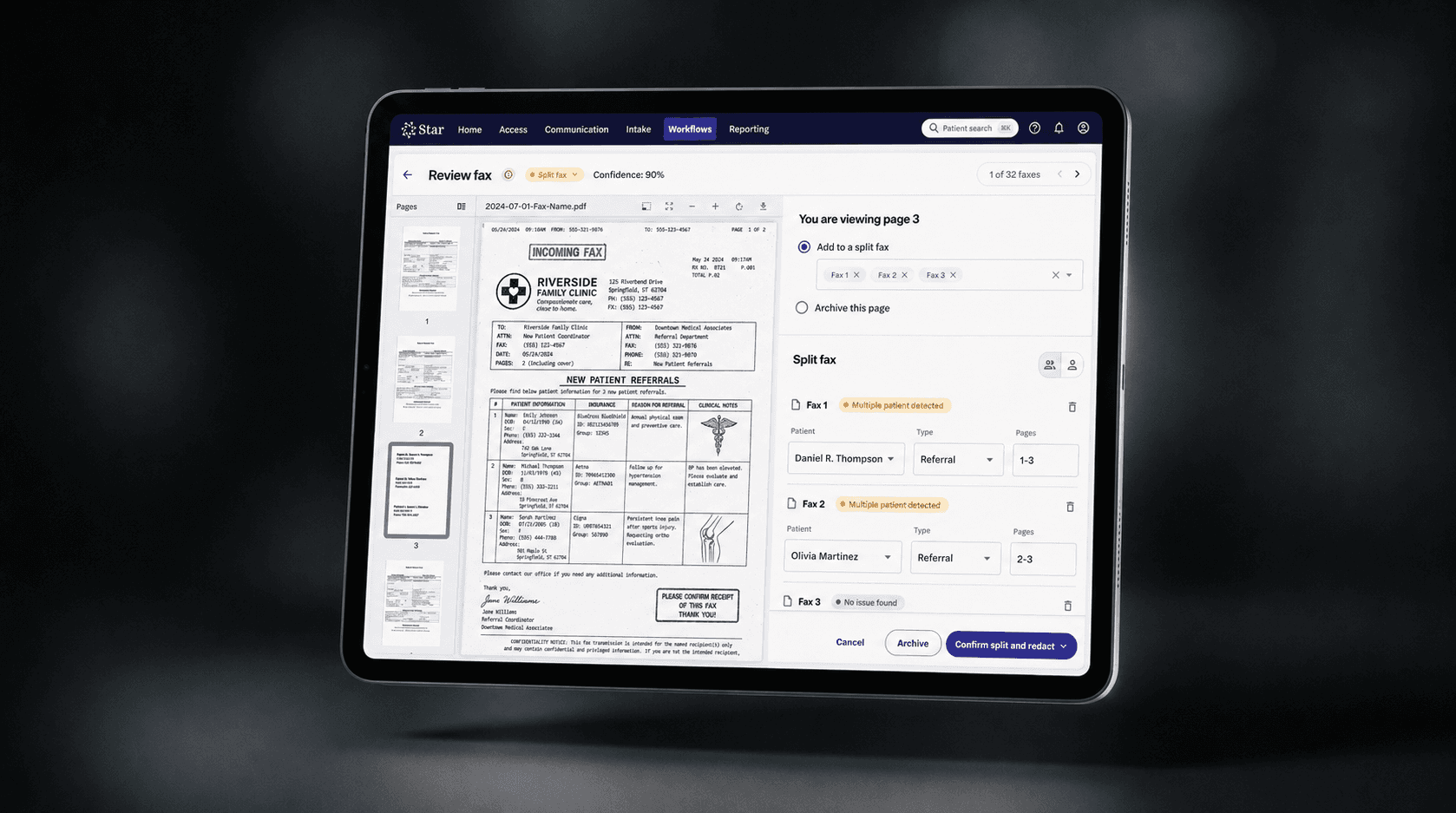
The reviewer opens a fax from the queue. Multi-patient faxes are already flagged. The document renders on the left; the right panel shows the current page and two options: add it to a split fax, or archive it.
02
Assign pages to patients
For each split fax, the reviewer selects the patient from a dropdown and sets the page range. Overlapping pages are allowed. The system flags "Multiple patient detected" where it finds shared content — the reviewer confirms or corrects.
03
Confirm the split
A modal summarises every resulting fax: patient name, document type, page range, and any PHI warnings. The reviewer can go back or confirm and move to redaction.
Flow 02 · Redact & Annotate
01
Review each fax
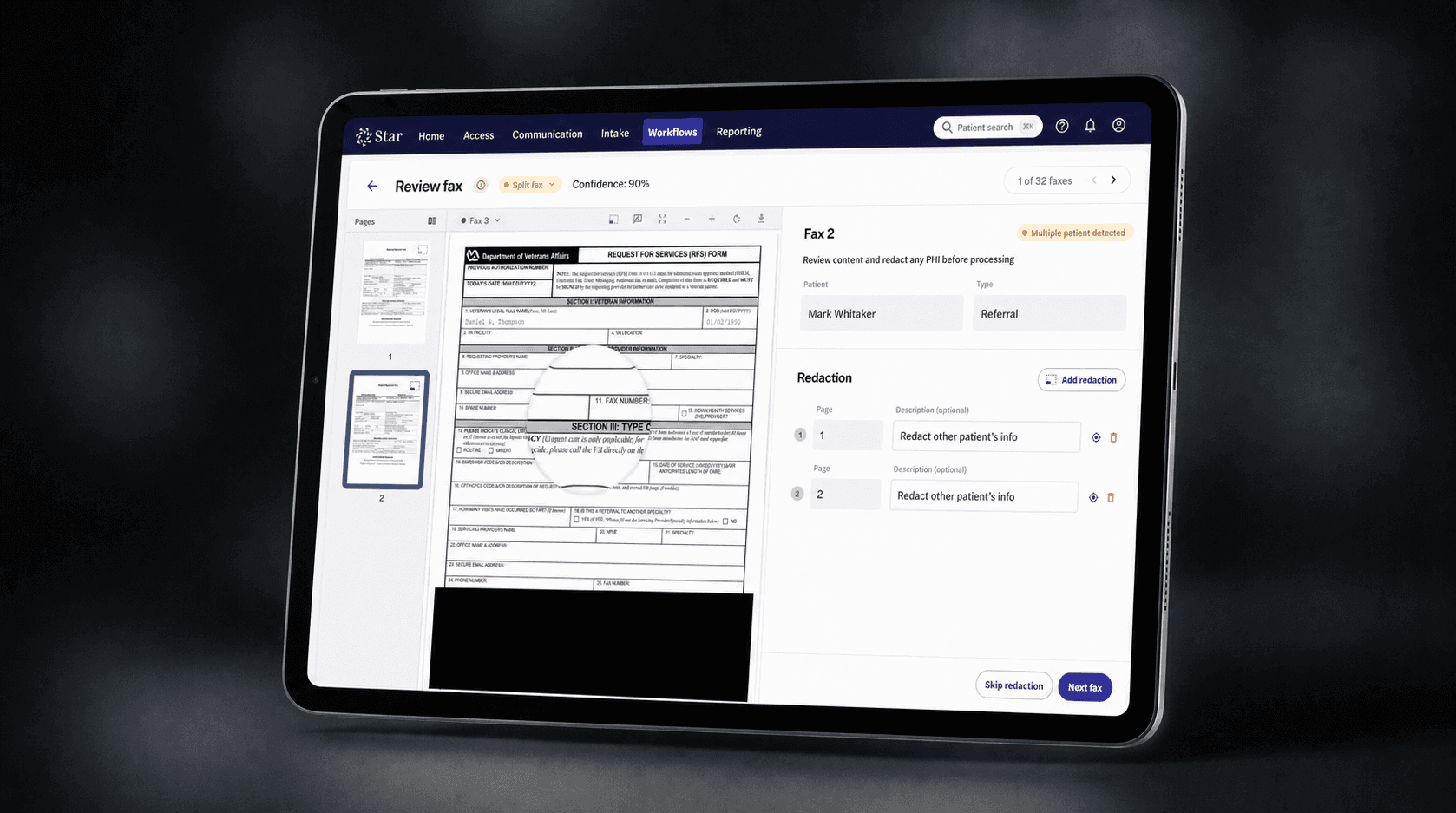
After splitting, each resulting fax opens for review in sequence. The source document stays on the left. The right panel shows the patient, document type, a redaction log, and an annotation area — both available at the same time, in the same pass.
02
Redact PHI
The reviewer adds redactions manually: page number and an optional description of what was removed. Each redaction is logged. Faxes with no PHI to redact can be skipped.
03
Annotate as needed
In the same panel, the reviewer can leave annotations — notes for whoever picks up the chart next. Redaction and annotation happen together, without switching screens or tools. One pass covers both.
04
Process the split
On the final fax, "Next fax" becomes "Process the split." Nothing moves to the chart until the reviewer makes that call. Everything — splits, redactions, annotations — is confirmed together.
07 · impact
The flow that made Fax Transform enterprise-ready.
The original product shipped as a clinic tool. Split, Redact, and Annotate was the work that let us walk into health-system procurement, survive legal review, and sign our first two enterprise contracts.
Craft principles
0
-
Reported PHI leaks across 410,000 reviewed faxes in the first 90 days of production.
1
hr
Enterprise contracts signed in the quarter after launch. Both cited the audit trail by name.
2
×
Enterprise contracts signed in the quarter after launch. Both cited the audit trail by name.
75
%
Reduction in time-to-review on multi-patient faxes. From around 2 min per page to 30 seconds.
08 · reflection
What the craft taught me.
The confirmation step is a design surface, not a checkbox.
The moment I started treating the confirm modal as a trust-building moment — not a legal formality — the whole flow clicked. Reviewers needed to see their work summarised before they committed to it. That's a product insight, not just a UX detail.
Audit is a design material.
The redaction log — page number, description, reviewer — wasn't a backend artifact. It was the thing that moved procurement from "maybe" to "yes." Treating it as a first-class product surface, visible to the reviewer before they submit, changed how legal thought about the tool.
One designer can own a flow end-to-end, if the flow is small enough.
Split, Redact, Annotate — three verbs. Owning all of it, from research to QA, meant the micro-decisions stayed coherent. The next flow should still be one designer, but I'd carve it smaller next time.